
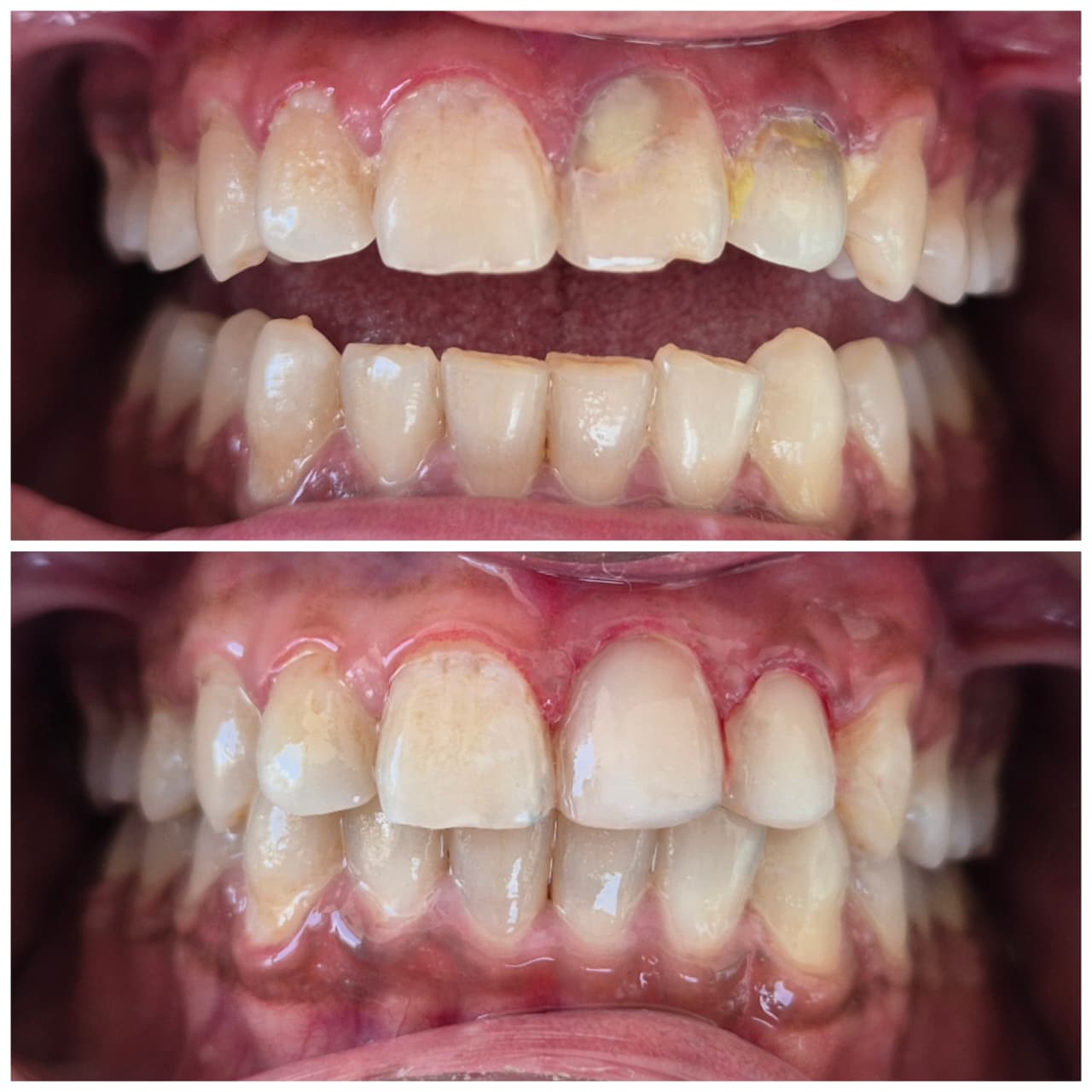
Real patient case, treated at Dr. Pithadia's Dental & Healthcare Clinic, Sector 14, Kharghar. Shared with the patient's consent.
A patient came to our Sector 14 clinic self-conscious about a cavity that had spread across two of his upper front teeth. The decay had left visible brown and yellow staining right where every smile shows it, and he'd been putting off treatment, worried a fix would mean a crown or would look obviously "done." We treated it with tooth-coloured composite filling at Dr. Pithadia's Dental & Healthcare Clinic in a single sitting, and the before-and-after above is one we're genuinely glad to share.
What Was Actually Wrong With the Tooth
On examination, the cavity in his front teeth had progressed past the point of a simple stain. Decay had softened the enamel and reached into the dentin underneath on both teeth, which is why the discolouration looked patchy rather than a clean white-to-brown line. Left alone, cavities like this don't stop; they keep spreading until they reach the nerve, and a filling stops being enough. Caught at this stage, though, it was still squarely in filling territory, not root canal or crown territory.
Why Composite Filling Was the Right Fix Here
For a cavity on a front tooth, a composite filling is usually the right call at our Kharghar clinic, and it was here. Composite is a tooth-coloured resin that we shape and bond directly onto the tooth, matching it to the shade of the teeth around it before it's set hard with a curing light. Unlike silver amalgam, which only ever looks like a filling, composite blends in well enough that most people can't spot it in a photograph, which matters most exactly where this cavity was: front and centre.
It also meant the treatment happened in one visit. There's no lab work, no waiting for a crown to be fabricated, and no wincing over the first hot chai afterward the way there can be with more involved restorative work. For a cavity that hadn't reached the nerve, that's about as straightforward as dental treatment gets. If your concern is less about one cavity and more your smile overall, our guide to smile makeover options in Kharghar covers the wider toolkit, whitening, veneers and bonding included.
How We Did the Composite Filling, Step by Step
Here's exactly how it went, in the order it happened at our Sector 14 clinic.
Removing the decay
The first step is always removing every trace of decayed tooth structure, under local anaesthetic and designed for comfort. Skipping any of it, even a small amount, is how fillings fail early, so this step gets more time than people expect.
Matching the shade
Before placing anything, we match the composite resin to the natural shade of the surrounding teeth using a shade guide, checked in natural light rather than the operatory light alone. This is the step that decides whether a filling on a front tooth blends in or looks slightly off, and it's not one to rush.
Layering and bonding
Composite is built up in thin layers rather than packed in all at once, with each layer cured hard with a light before the next goes on. Layering this way controls shrinkage and lets us sculpt the natural contours of the tooth, the slight curves and edges that make a front tooth look like a tooth and not a flat patch.
Shaping and polishing
The last step is shaping the filling to match the bite and polishing it to the same shine as the enamel around it. That's what makes the difference between a filling you can see and one you can't, and it's also why the finished result holds up under normal brushing and eating rather than staining or roughening over time.
What a Composite Filling Costs in Kharghar
A composite filling at Dr. Pithadia's Dental & Healthcare Clinic generally starts from ₹1,200 per tooth, though the final cost depends on the size of the cavity, how many surfaces of the tooth are involved, and how much shade-matching and shaping the case needs. A cavity spanning two front teeth, like this one, sits above the simplest single-surface fillings for that reason.
Exact pricing depends on case complexity. At your consultation in Sector 14, Kharghar, we'll examine the tooth, take an X-ray if needed, and give you a clear figure before any work begins.
When a Filling Alone Isn't Enough
Here's the honest limit of what a filling can do, and it's worth saying plainly: not every cavity on a front tooth can be fixed this way. If decay has reached the nerve, a filling won't hold, and the tooth needs root canal treatment before anything is rebuilt on top. If too much of the natural tooth structure is gone, a filling has nothing solid to bond to, and a crown or veneer becomes the more durable option. This is where being seen by a prosthodontist and cosmetic dentist, rather than being handed a generic answer, actually matters. Dr. Urvashi Pithadia, BDS, Prosthodontist and Cosmetic/Aesthetic Dentist, checks how much healthy tooth remains before recommending a filling, rather than defaulting to the simplest fix and hoping it holds.
In this case, the tooth was intact enough that a filling was the right, and simpler, answer. It won't always be, and knowing the difference before starting is what protects you from redoing the work later.
Frequently Asked Questions
Will a composite filling on a front tooth look natural?
Yes, when it's shade-matched and shaped properly. Composite resin is tinted to match the surrounding teeth and polished to the same shine as natural enamel, which is why it's the standard choice for cavities and chips on front teeth rather than silver amalgam, which never blends in.
How long do composite fillings last on front teeth?
Front-tooth composite fillings typically last five to ten years, sometimes longer, according to Cleveland Clinic. Front teeth carry less chewing force than molars, which works in the filling's favour, though how long yours lasts also depends on your bite and oral hygiene.
Is a composite filling better than a silver filling for front teeth?
For front teeth specifically, yes, mainly for appearance. Silver amalgam is strong and long-lasting, but it stays visibly grey and never matches the tooth. Composite trades a little of that raw strength for a result that blends in, which is usually the priority for a tooth that shows every time you smile.
Is getting a composite filling painful?
The procedure is carried out under local anaesthetic and designed for comfort, so you'll feel pressure and vibration rather than pain. Some mild sensitivity to hot or cold for a day or two afterward is normal and settles on its own.
Can every cavity on a front tooth be fixed with just a filling?
No, and it's worth knowing that before you assume it. If decay has reached the nerve, or too little healthy tooth structure remains to bond to, a filling isn't enough on its own, and root canal treatment or a crown becomes the better route. That's assessed case by case, not assumed either way.
How do I take care of a composite filling afterward?
Day-to-day care is the same as for your natural teeth: brushing twice a day, cleaning between your teeth, and avoiding using your front teeth to bite down on very hard things like ice or pen caps, which can chip the edge of a filling over time. Regular check-ups let us catch any wear early.
Book a Cavity Check in Sector 14, Kharghar
If a cavity on a front tooth has been making you self-conscious about smiling in photos, an unhurried consultation is the place to start. Dr. Urvashi Pithadia will examine the tooth, tell you honestly whether a composite filling is enough or whether it needs more, and treat it in one sitting where possible. You'll find Dr. Pithadia's Dental & Healthcare Clinic at 21st Floor, Kamdhenu Commerz, 2101-2103, Above Zudio, Sector 14, Kharghar, Panvel, Navi Mumbai, Maharashtra 410210. Message us on WhatsApp or book online to get started.