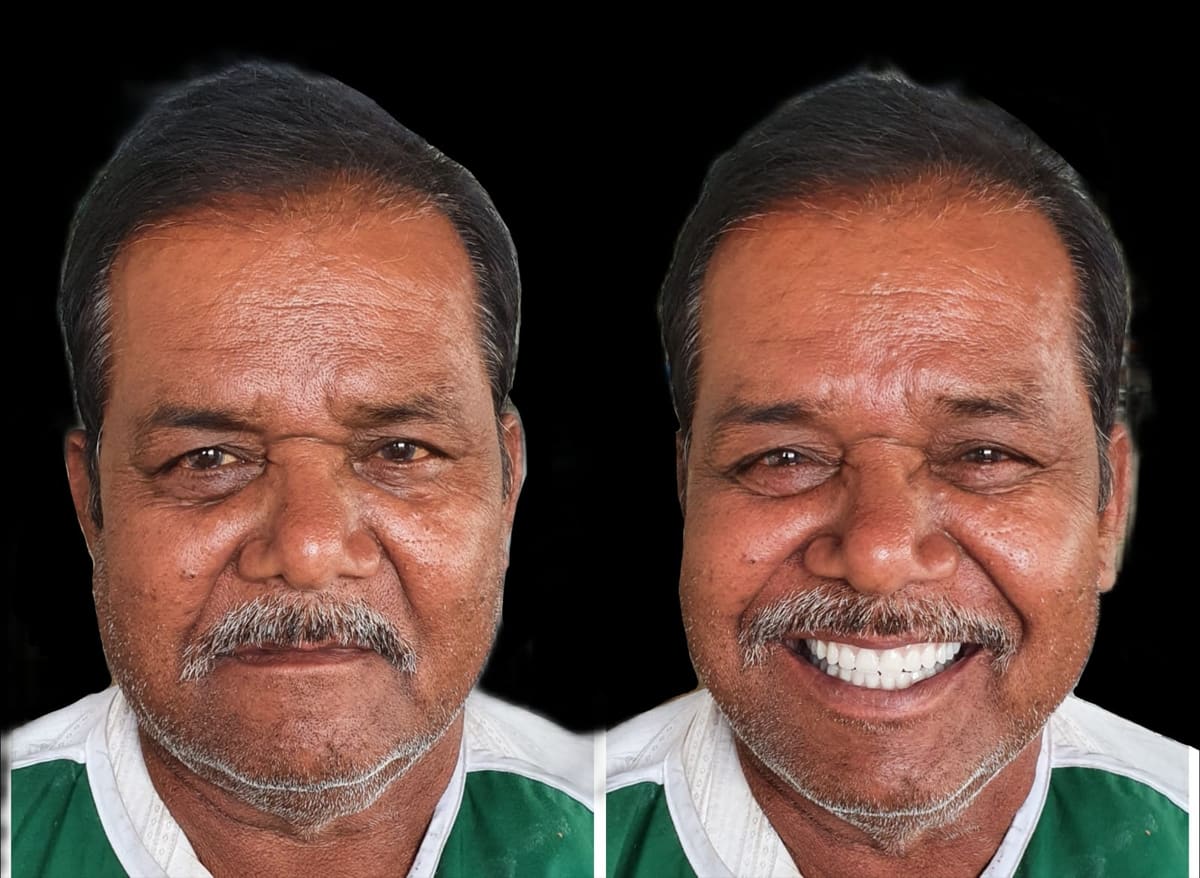
Real patient case, treated at Dr. Pithadia's Dental & Healthcare Clinic, Sector 14, Kharghar. Shared with the patient's consent.
A patient came to our Sector 14 clinic with a problem he'd been living with for a while: missing teeth had made it genuinely hard to chew his food, and he'd stopped smiling the way he used to. After examining what natural teeth he had left, we laid out three real ways to fix it. He chose an implant-supported overdenture, and the photo above is his result: he can chew properly again, and his smile is back.
What We Found on Examination
Before recommending anything, we looked at the condition of his remaining teeth, his gums and the bone underneath. Missing teeth don't just leave a gap; the jawbone under an empty space slowly resorbs over time, and the teeth around it can drift or take on more chewing load than they were built for. In his case, enough natural teeth and bone remained to support a few strategically placed implants, which is what opened up more than one treatment path.
Missing teeth are far more common than most people assume. The American College of Prosthodontists estimates that well over 120 million people are missing at least one tooth, and tens of millions have lost all of theirs. It's not a rare problem walking into a Kharghar clinic; it's one of the most common reasons people come to see a prosthodontist in the first place.
Three Ways to Replace His Missing Teeth
We don't hand a patient one option and call it a plan. We explained all three routes that genuinely applied to his case, with the honest trade-offs of each.
- Full mouth implant-supported fixed teeth. A complete set of teeth permanently fixed onto multiple implants; it doesn't come out, and it feels and functions closest to natural teeth. It also needs the most implants, the most bone, and the highest budget of the three.
- Implant-supported overdenture. A denture that clips securely onto a smaller number of implants, giving a far steadier hold than a denture resting on the gums alone, while still coming out for cleaning at night.
- Complete denture. A traditional removable denture with no implants at all: the least involved option, and also the least stable one, since it relies entirely on the gums and suction to stay in place.
For a wider look at how these choices compare in general, our guide to types of dentures in Kharghar covers the same three-way decision.
Why He Chose an Implant-Supported Overdenture
He chose the middle path, and for his situation, it was the right call. A full mouth fixed implant solution would have meant more implants, a longer bone-graft-and-heal timeline in places where his bone had thinned, and a cost well beyond what he was ready to commit to. A complete denture would have been the quickest, lowest-cost option, but he'd almost certainly have been back in our chair within a year or two, frustrated by the same slipping and clicking that made chewing difficult in the first place.
An implant-supported overdenture gave him a middle ground that actually matched his needs: a small number of implants anchoring the denture firmly enough that it doesn't shift when he's eating or talking, at a fraction of the implant count and cost of a fully fixed arch. It's also easier to keep clean, since it comes out for a proper brush every night, which matters for a patient who wanted low daily maintenance.
To be clear about when this isn't the right answer: if a patient has strong bone, a bigger budget, and wants teeth that never come out at all, full mouth fixed implants are usually the better fit. And if implants of any kind aren't an option, whether due to health, bone volume, or budget, a well-fitted complete denture still has its place. There isn't one correct answer for every patient; there's the answer that fits this mouth, this budget, and this person's daily life.
How the Treatment Went
Planning and implant placement
Once he chose the overdenture route, we planned the number and position of implants needed to support it, based on his bone volume and bite. The implants were placed under local anaesthetic, designed for comfort throughout.
Healing and osseointegration
After placement, the implants need time to fuse with the jawbone, a process called osseointegration. This is the step that can't be rushed; the strength of the final result depends on the implants integrating properly before any load is put on them.
Fitting the overdenture
Once healing was complete, the overdenture was fitted to clip onto the implants, checked and adjusted for bite and fit. The difference from a regular denture is immediate: it locks into place instead of resting loosely on the gums.
The Result
The before-and-after above is his own reaction, not a posed after-photo. He's chewing his food properly again, which had genuinely stopped being possible before treatment, and he's smiling without holding back. That combination, function and confidence together, is what we're aiming for with every full mouth rehabilitation case at our Sector 14, Kharghar clinic, and it's the part of this job that doesn't get old.
Frequently Asked Questions
What is an implant-supported overdenture?
It's a removable denture that clips onto a small number of dental implants placed in the jaw, instead of resting loosely on the gums like a conventional denture. The implants give it a far steadier hold, while it still comes out for cleaning.
How is it different from a regular complete denture?
A regular complete denture relies entirely on suction and the shape of your gums to stay in place, which is why it can slip while eating or talking. An implant-supported overdenture clips onto implants underneath it, so it stays put through normal chewing.
Why didn't he choose full mouth fixed implants instead?
Full mouth fixed implants need more implants, more bone volume, a longer treatment timeline, and a larger budget. His case suited an overdenture better: enough stability to chew normally, without the cost and bone requirements of a fully fixed arch.
How long does an implant-supported overdenture last?
The implants themselves are designed to last many years with proper care and regular check-ups. The denture portion that clips onto them will need periodic relining or eventual replacement as your bite and gum tissue change over time, which we monitor at review visits.
Can you eat normally with an implant-supported overdenture?
Yes, that's the main reason patients choose this option over a conventional denture. Because it's anchored to implants rather than resting on the gums, it holds steady enough for most patients to chew a normal diet with confidence.
What does an implant-supported overdenture cost in Kharghar?
It depends on how many implants your case needs, your bone volume, and the type of attachment used, so we won't quote a figure that doesn't apply to your mouth. At a consultation in Sector 14, Kharghar, we'll examine your case and give you a clear estimate before any work begins.
Book a Consultation in Sector 14, Kharghar
If missing teeth are making it hard to chew or hard to smile, an unhurried consultation is the place to start. Dr. Urvashi Pithadia, BDS, Prosthodontist and Cosmetic/Aesthetic Dentist, will examine your case and walk you through which of these options, fixed implants, an implant-supported overdenture, or a complete denture, actually fits your mouth and your life. You'll find Dr. Pithadia's Dental & Healthcare Clinic at 21st Floor, Kamdhenu Commerz, 2101-2103, Above Zudio, Sector 14, Kharghar, Panvel, Navi Mumbai, Maharashtra 410210. Message us on WhatsApp or book online to get started. You can also read more about dental implants or dentures at our Kharghar clinic.